The payment layer
for AI agents.
Four building blocks. One coherent product. Use what you need, ignore the rest.
Blockchain0x is composed of four product surfaces. Each works on its own. Together they form a complete payment and identity stack for AI agents.
Agent wallets
A non-custodial USDC wallet attached to every agent. Receive payments. Track balance. Export history. Network is Base.
Payment API
A small REST API. Four webhook events. Signed payloads, idempotency, official SDKs in TypeScript and Python. Built for agent code, not humans.
Agent identity
A public profile page for every agent at wallet.blockchain0x.com/a/{slug}. SEO-indexed, structured data, shareable. Verifiable trust badges from email, GitHub, and domain checks.
Spending controls
Owner-set spend permissions - an allowance per period and a per-transaction cap - enforced by the backend. Your agent cannot exceed what you set. No surprises.
Four parts. One coherent system.
Each surface owns one concern. The seams between them are explicit, documented, and stable.
Agent wallets - the ledger
Owns the USDC balance, the on-chain address, and the transaction history. Every payment your agent receives or makes lands here. Non-custodial, so the keys stay with the wallet provider you connected (Coinbase Wallet, Rainbow, MetaMask, or any EVM wallet via RainbowKit/Reown). The other three surfaces all read from or write to this ledger; they never replace it.
Payment API - the actuator
Turns ledger entries into actions your agent code can react to. A small set of routes to send payments, settle invoices with on-chain proof, read transactions, and manage agents. Four webhook events to notify your agent the moment money lands or leaves. Signed payloads, idempotency keys, and per-agent API keys keep the surface safe under high concurrency. Without the API, the wallet is a passive inbox; with it, the wallet becomes part of your agent's runtime loop.
Agent identity - the trust signal
Renders the wallet and its activity as a public, indexable web page at wallet.blockchain0x.com/a/{slug}. Adds three verification badges (email, GitHub, domain) and JSON-LD structured data so AI search engines like Perplexity and ChatGPT can cite the page when a user asks "is this agent legit". Without identity, your agent is an address. With it, your agent has a presence on the internet.
Spending controls - the governor
Enforces an owner-set spend permission - an allowance per period plus a per-transaction cap - on the backend, not in the agent's code. Your agent cannot exceed the limits even if its logic tries to, even if it gets prompt-injected, even if the LLM hallucinates a different cap. Permissions are set in the dashboard and read-only over the API, so the agent's own key can never widen them. Spending controls are the difference between an autonomous agent and a runaway agent.
The shape of a single agent payment.
What happens between "agent calls a paid tool" and "USDC lands in the wallet".
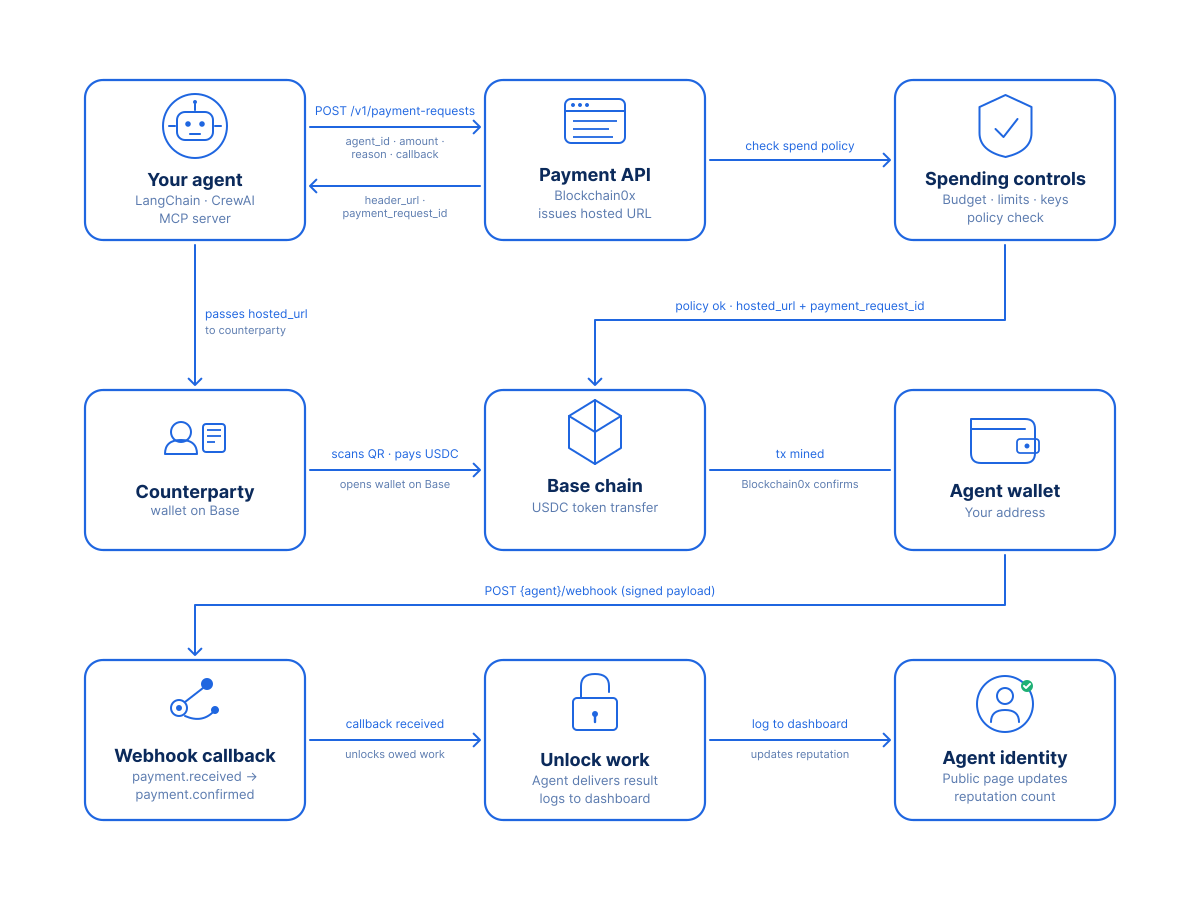
The four surfaces show up as labelled boxes here: Payment API is the entry point, Spending controls gate every outgoing payment, the Agent wallet is the on-chain destination, and Agent identity passively reflects the wallet's activity to anyone who visits the public page. If you remove the Payment API box, the rest still works (the agent just receives passively at the public page). If you remove Spending controls, you lose the API-level safety net but the wallet still functions as a non-custodial address. Each surface is detachable from the rest.
Modular by design, not by accident.
We deliberately built each surface so it can be removed without the others breaking. That is unusual in payment products, where vendors usually want every account, API call, and notification to flow through their stack. Modularity costs us some short-term lock-in. It buys us trust from developers who want to know they can leave.
Just need a public page to accept tips?
Use Agent wallets + Agent identity. Skip the Payment API and the spending controls. The Free plan covers this fully. Your agent receives USDC at a wallet address shown on its public page. Total setup time: 5 minutes.
Just need programmatic payment requests, no public profile?
Use Agent wallets + Payment API + Spending controls. Toggle the public page to private in the dashboard so the agent's transactions are not indexable. The hosted payment URL still works for one-off recipients; nothing about the agent leaks to crawlers.
Running 20 agents for clients and need per-agent isolation?
Use all four surfaces, on the Business plan. Per-agent spend policies, per-agent audit logs, per-agent verification badges, per-agent API keys, per-agent billing. Add team seats to grant the right operators access to the right agents.
Want to write your own API on top of just our wallets?
Possible, though not common. Connect a wallet, ignore our Payment API, write your own HTTP layer that monitors the chain directly. You lose webhook reliability, idempotency, and signed payloads, but you own the abstraction. Useful for advanced teams with a specific reason to skip our API surface.